A Fair Share for Our Roads
The Shire of Pingelly maintains 587 km of local roads, the funding for which is determined largely by the Australian and Western Australian Governments. This page outlines the condition and cost of the road network, the advocacy the Shire is undertaking to secure fairer funding, and how residents and road users can support that work.
Who decides
While the Shire is responsible for maintaining the local road network and setting works priorities, its road expenditure of $3.1M already exceeds total rate revenue of $2.8M. The overall level of road funding is therefore dependent on decisions made by the Australian and Western Australian Governments.
|
FEDERAL GOVERNMENT
Canberra
Sets Financial Assistance Grants (untied funding) and Roads to Recovery.
|
WA GOVERNMENT
Perth
Sets the State Road Funds to Local Government Agreement, currently 20% of vehicle licence fees, and funding for regional freight routes.
|
SHIRE OF PINGELLY
Pingelly
Levies rates, secures grant funding, maintains the network and sets priorities in consultation with the community.
|
Local roads and national productivity
Lifting national productivity is a stated priority of the Australian Government, and in regional Australia productivity depends heavily on the local road network. Grain, livestock, fertiliser and fuel in the Wheatbelt are carried on local roads before reaching the state highway, rail and port networks.
Local governments are responsible for approximately 77% of Australia's road network. In Western Australia, local governments manage 87% of the State's public road network, yet receive just 20% of vehicle licence fee revenue and fund half of all local road spending from their own sources. Agriculture underpins the Wheatbelt's $9.2 billion regional economy, with wheat ($1.54 billion), barley ($759 million) and canola ($425 million) the region's principal commodities, nearly all of which relies on council-managed roads for the first stage of transport.
|
The impact of deteriorating roads
· Reduced freight efficiency: poor surface condition and pavement edges lower travel speeds and lengthen haulage times during harvest.
· Increased operating costs: wear on heavy vehicles, tyres, school buses and agricultural machinery rises as road condition declines.
· Access restrictions: weakened pavements and ageing bridges can require load limits and detours for heavy vehicles.
· A growing renewal backlog: where funding is insufficient, councils must defer renewal in favour of short-term maintenance, and the backlog increases.
|
|
The economic return on local government investment
Research released by the Australian Local Government Association estimates that an additional $1 billion invested annually in local government roads would increase national GDP by approximately $3.5 billion a year. In its March 2026 submission on productivity in Australia, ALGA also argued that local productivity gains are closely linked to funding certainty and flexibility, and are currently constrained by the intergovernmental funding framework. In regional communities, a significant proportion of this investment circulates within the local economy.
· Local employment: road programs employ Shire staff and local contractors who live and spend within the district.
· Local procurement: materials, fuel, plant hire, servicing and accommodation are sourced locally where possible.
· Business productivity: improved roads reduce costs for primary producers and transport operators, retaining more income in the regional economy.
· Community sustainability: this activity supports local businesses and the population on which schools, sporting clubs and volunteer emergency services depend.
|
Restoring Financial Assistance Grants to 1% of Commonwealth taxation revenue is therefore an investment in national productivity, with benefits that flow directly to regional communities.
Our Roads 2026/27
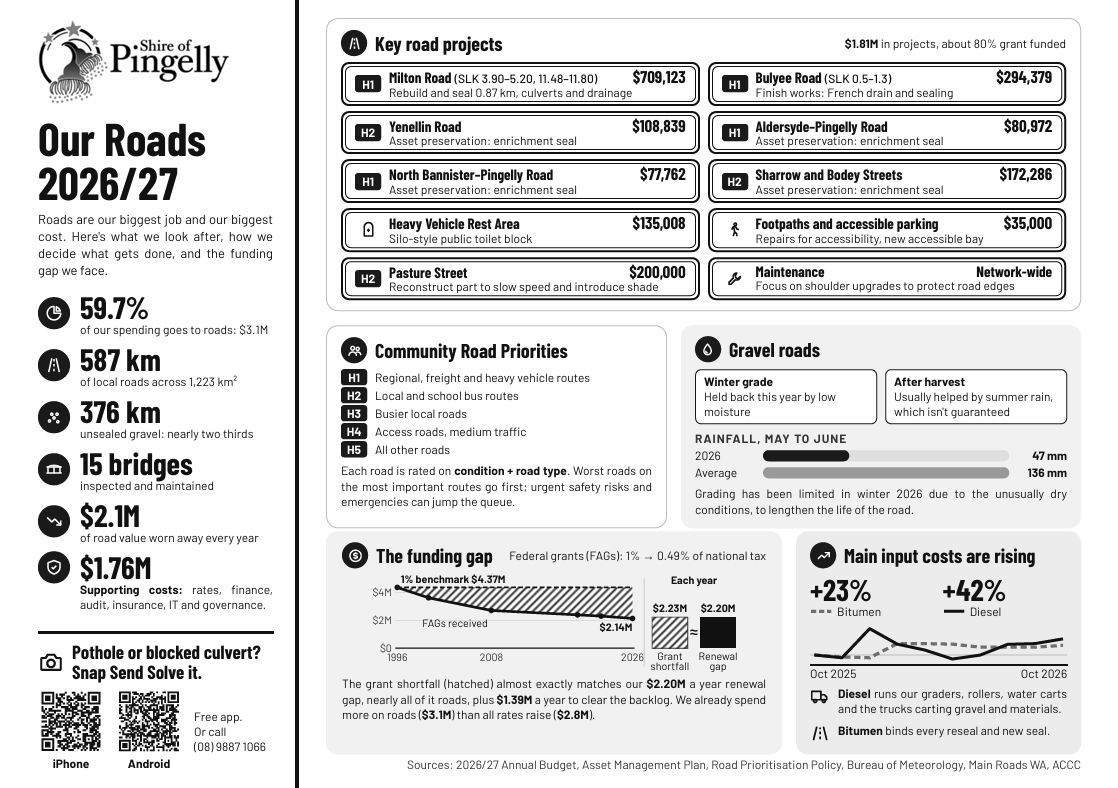
The Shire's one-page roads dashboard summarises the 2026/27 program, including key road projects, the Community Road Priorities, gravel road maintenance, the funding gap and rising input costs.
|
$82,000
per 100 m
|
What it costs to rebuild a road
Reconstructing and sealing a rural road, including drainage, costs approximately $82,000 per 100 metres. At that rate, the Shire's $2.2M annual renewal gap is equivalent to approximately 2.7 km of road reconstruction each year.
|
Funding advocacy underway
In addition to applying for every available road grant, the Shire is pursuing increased funding through the peak bodies that negotiate on behalf of local government, ensuring Pingelly's position is presented to the decision makers who set the budgets.
|
APPLIED
Every available road grant
WHAT WE DID The Shire has applied for every road funding program available to it, including:
· Black Spot Program
· Commodity Routes Fund
· Roads to Recovery
· Regional Road Group funding
While these grants fund approximately 80% of this year's construction program, they are tied to specific projects and do not address the ongoing renewal gap.
|
|
DONE
Federal inquiry
WHAT WE DID The Shire made two submissions to the federal Inquiry into Local Government Funding and Fiscal Sustainability, and the Chief Executive Officer and Shire President presented to the Committee, with a focus on roads and Financial Assistance Grants.
|
|
THROUGH ALGA
2027–28 federal budget
THE ASK Restoration of Financial Assistance Grants to 1% of Commonwealth taxation revenue, an outcome the Australian Local Government Association is pursuing on behalf of all councils.
|
|
THROUGH WALGA
WA road funding agreement
THE ASK An improved State Road Funds to Local Government Agreement to replace the current Agreement, which provides 20% of vehicle licence fee revenue and expires in 2027–28. WALGA is representing the Shire in these negotiations.
|
|
THROUGH WSFN
WA state budget
THE ASK Renewed funding for the Wheatbelt Secondary Freight Network, which carries the heavy grain freight responsible for much of the wear on local roads.
|
Positions of industry and local government bodies
The Shire's position is shared by peak bodies representing local government, agriculture and the freight industry, each of which is seeking increased investment in local roads.
Write to your Members of Parliament
Residents, businesses and industry bodies are encouraged to write to their Members of Parliament and the relevant federal Ministers, as a brief, personal letter describing the road you use and its impact is an effective way to support the Shire's advocacy. The request is the same regardless of which party is in government.
The four letters are included at the end of this document. Please complete the highlighted details and retain the resident, business or industry body paragraph that applies to you before emailing or posting the letter.
|
SEND TO
|
EMAIL
|
|
Mr Rick Wilson MP
Federal Member for O'Connor
|
rick.wilson.mp@aph.gov.au
|
|
Mr Lachlan Hunter MLA
Member for Central Wheatbelt
|
lachlan.hunter@mp.wa.gov.au
|
|
The Hon Catherine King MP
Minister for Infrastructure, Transport, Regional Development and Local Government
|
Minister.King@mo.infrastructure.gov.au
|
|
The Hon Dr Jim Chalmers MP
Treasurer
|
Online form (no public email)
|
Outside Pingelly? Find your Members through the AEC electorate finder and the WA Electoral Commission.
Information for road users
Primary producers, transport operators and local businesses are well placed to demonstrate the impact of road condition to decision makers, and information on tonnages, trips, repairs and delays gives the funding case valuable local substance.
|
Write as a business
Using the business paragraph in the letters above, describe the freight you carry, how frequently you use the road, and the cost of poor road condition in repairs, tyres and time.
|
|
Write as an industry body
Farming, grain and transport associations can use the industry body paragraph to write on behalf of their members, setting out what Wheatbelt roads carry for the industry and the cost of poor road condition to members.
|
Pothole or blocked culvert? Snap Send Solve it.
|
The Shire remains responsible for the day-to-day maintenance of local roads. Reports lodged through the free Snap Send Solve app are sent directly to the Shire, or you can contact the Shire on (08) 9887 1066.
|
iPhone

|
Android

|
Read More on A Fair Share for Our Roads
Pingelly Roads Dashboard 2026-27